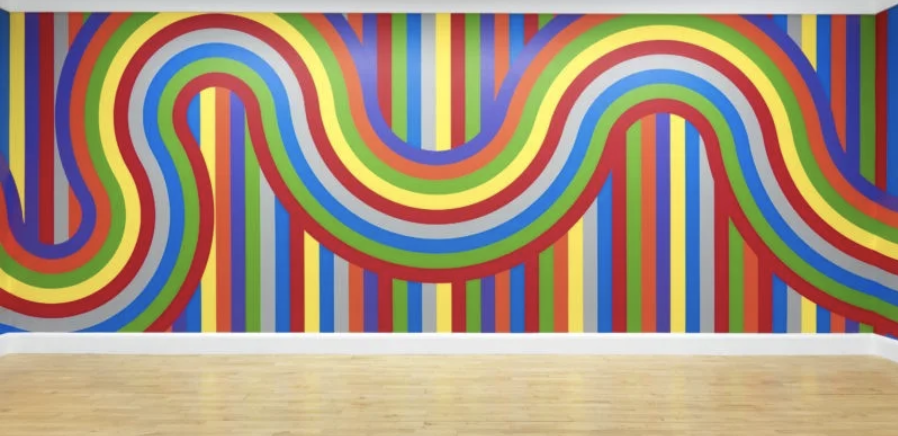
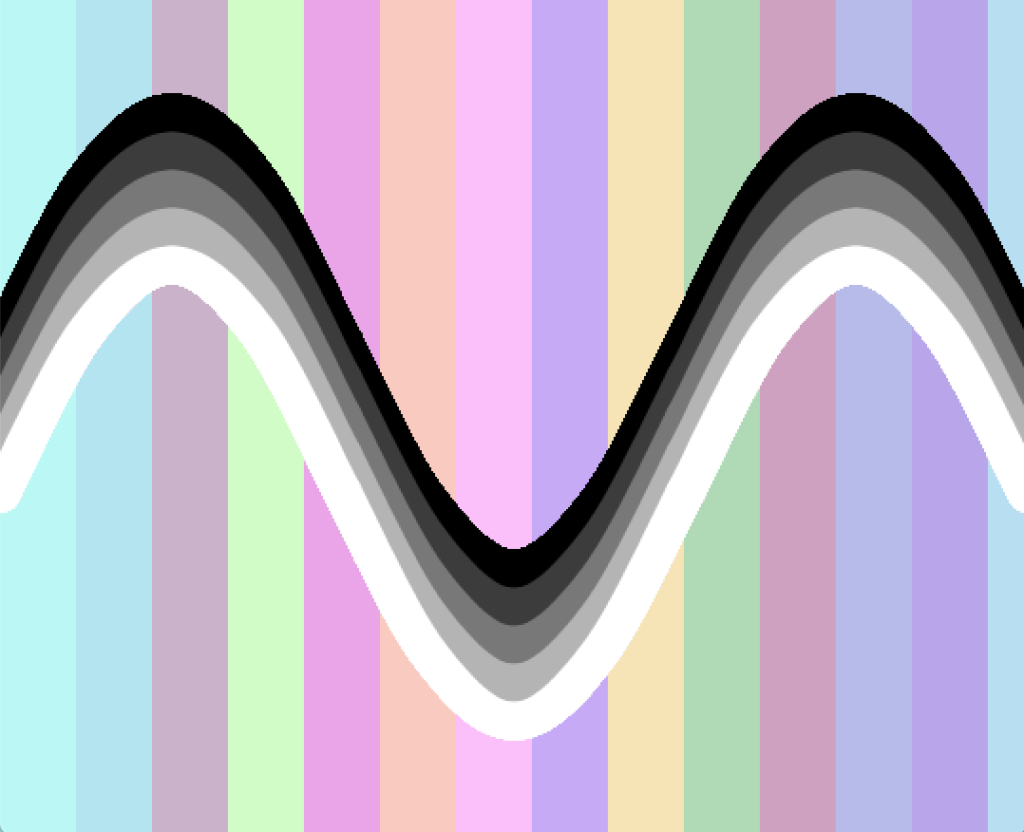
I was inspired by Sol Lewitt’s drawings of simple different coloured lines and I tried to imitate it but changed the colour scheme: his were bright and bold, I juxtaposed a pastel background against a monochrome wave. I wanted to use this to make the wave stand out more so the viewer would be immediately drawn to it. I also tried to make the waves more regular by making them go straight up and down unlike Lewitt’s which had a bit of a tilt.
Is there any value in recreating an existing image/drawing/graphic using computational media? What is it?
Yes, it is in step with the developing technological world. As we improve other parts of our lives, with technology/computational media, it is natural artists want to experiment with new materials and natural that viewers are also drawn to this style. If people rejected new materials/ideas as a whole, we would still be appreciating cave art! To recreate existing works, one can compare and contrast the two works and reflect on the changing times. The value here is that art, like everything else, is constantly developing and changing and do muse the past and present together, we can recreate things to appreciate both styles.
Do you think that both, hand and computational drawings cause the same feelings in the viewer?
Yes and no. If the drawings correctly conveyed the feelings to the viewer, then they would be the same, however, they may be for different reasons. For example, a viewer could look at a traditional oil painting and praise the technique, colours and the texture. However, at the digital work, they would be in awe of the code behind it, of the idea that the artist came up with. Both feelings would be one of awe, but at different aspects.
Do you think technology will replace humans in the future? What about art? Using the computer?
I think technology will replace humans in some future jobs, but not the entire human race if we are careful when developing new technology. In the video, Casey Reas said about artists “[the artist] injects their interpretation, every time it’s performed it’s performed differently”. This also matches with Vera Molnar’s quotation in the reading “in spite of their advantages, computers, no more than other simple tools, do not guarantee that a work of art of good quality would result, for it is the artist’s skill that is the decisive factor”. Like I mentioned above, it is the artist that produces the feelings and messages through the artwork, and the material is their choice to help convey these ideas. Computers, which can just be seen as regular paint here, do not do that so the value of art and the messages and thought process behind it cannot be replaced by computers.
code (for final video):
int a = 0;
int b = 60;
int c = 60;
float d = 0;
void setup () {
size (540, 440);
}
void draw () {
a=0;
while (a<width) {
pushMatrix();
frameRate(1);
fill (random(170, 255), random(160, 255), random(180, 255));
noStroke();
rect(a, 0, 40, height);
a=a+40;
monosincurve();
if (key==’b’) {
a=0;
while (a<width) {
frameRate(1);
fill (random(255));
noStroke();
rect(a, 0, 40, height);
a=a+40;
}//while loop
stroke(3,4,94);
sincurve(180);
stroke(2,62,138);
sincurve(200);
stroke(0,119,182);
sincurve(220);
stroke(0,180,216);
sincurve(240);
stroke(72,202,228);
sincurve(260);
} //if loop
popMatrix();
} // while
} // void draw
/void newbackground () { while (a/
void sincurve (float d) {
noFill();
strokeWeight(20);
beginShape();
curveVertex(0, d); // the first control point
curveVertex(0, d); // is also the start point of curve
curveVertex(45, d-84.4);
curveVertex(90, d-120);
curveVertex(135, d-84.4);
curveVertex(180, d);// the last point of curve
curveVertex(180, d); // is also the last control point
endShape();
beginShape();
curveVertex(180, d); // the first control point
curveVertex(180, d); // is also the start point of curve
curveVertex(225, d+84.4);
curveVertex(270, d+120);
curveVertex(315, d+84.4);
curveVertex(360, d);// the last point of curve
curveVertex(360, d); // is also the last control point
endShape();
beginShape();
curveVertex(360, d); // the first control point
curveVertex(360, d); // is also the start point of curve
curveVertex(405, d-84.4);
curveVertex(450, d-120);
curveVertex(495, d-84.4);
curveVertex(540, d);// the last point of curve
curveVertex(540, d); // is also the last control point
endShape();
}
/void keyPressed () { coloredsincurve(); }/
void coloredsincurve() {
stroke(random(170, 255), random(160, 255), random(180, 255));
sincurve(180);
stroke(random(170, 255), random(160, 255), random(180, 255));
sincurve(200);
stroke(random(170, 255), random(160, 255), random(180, 255));
sincurve(220);
stroke(random(170, 255), random(160, 255), random(180, 255));
sincurve(240);
stroke(random(170, 255), random(160, 255), random(180, 255));
sincurve(260);
}
void monosincurve() {
stroke(0);
sincurve(180);
stroke(60);
sincurve(200);
stroke(120);
sincurve(220);
stroke(180);
sincurve(240);
stroke(255);
sincurve(260);
}
Leave a Reply
You must be logged in to post a comment.